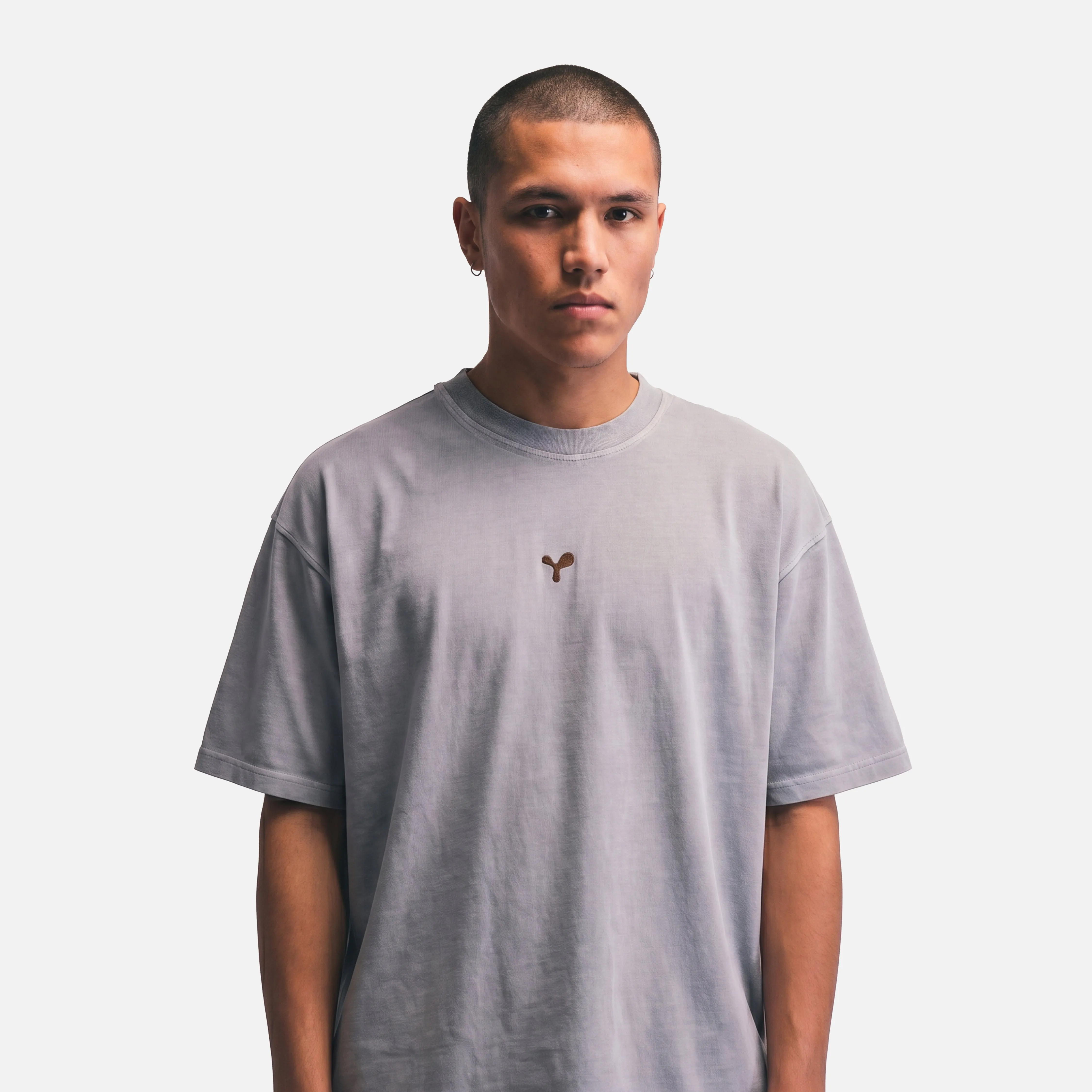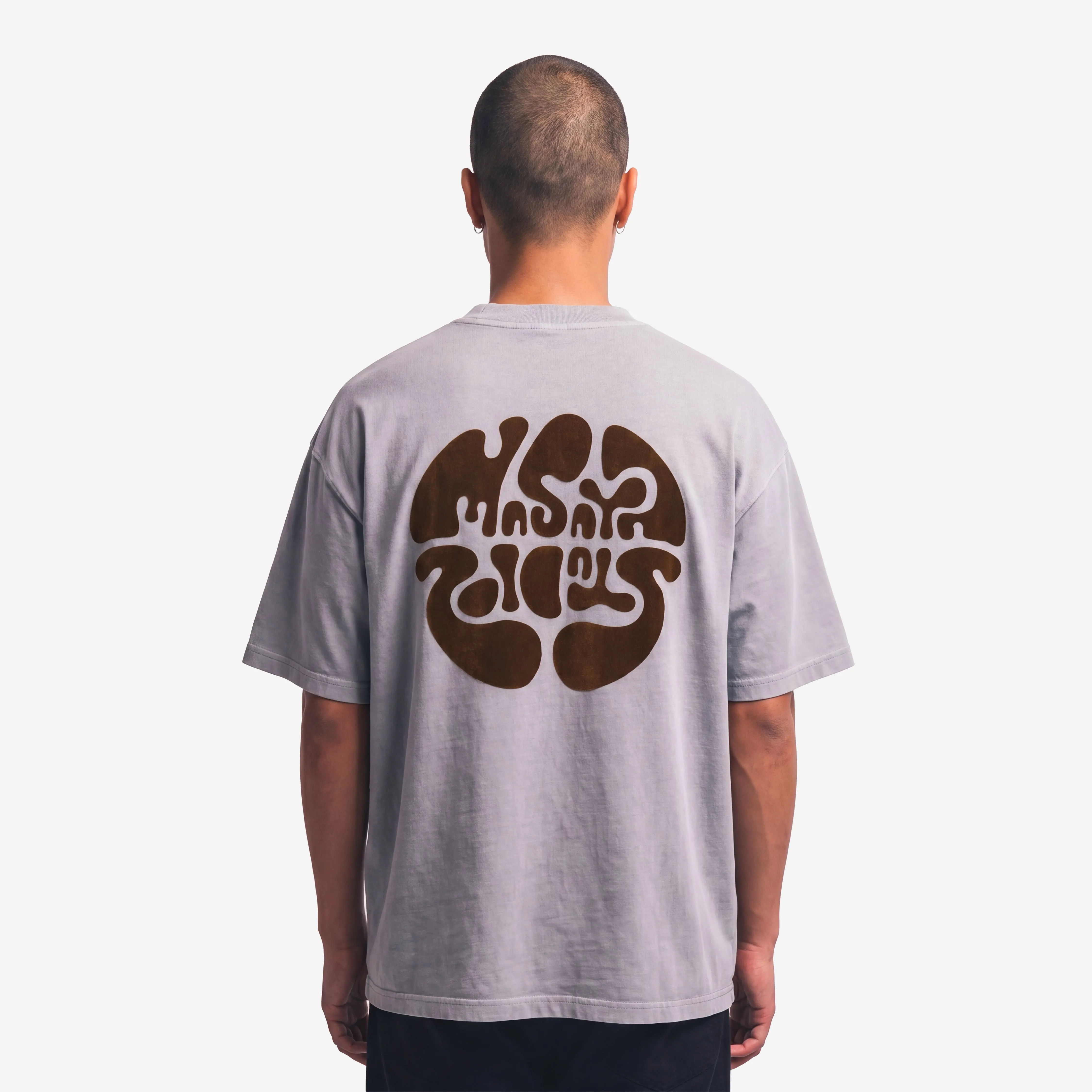
Flocking print, from the wearing side
Flocking print bonds short textile fibres to fabric through an adhesive film, giving a raised, velvet-like surface. It differs from puff print, which is ink that foams under heat into a smooth 3D dome. Flock's durability depends on fibre density, adhesive quality and press temperature — not on the technique itself.
Måns Engblom ·
Search for flocking print and you get printing suppliers. Useful if you are buying a machine, less useful if you want to know what the thing feels like after twenty washes.
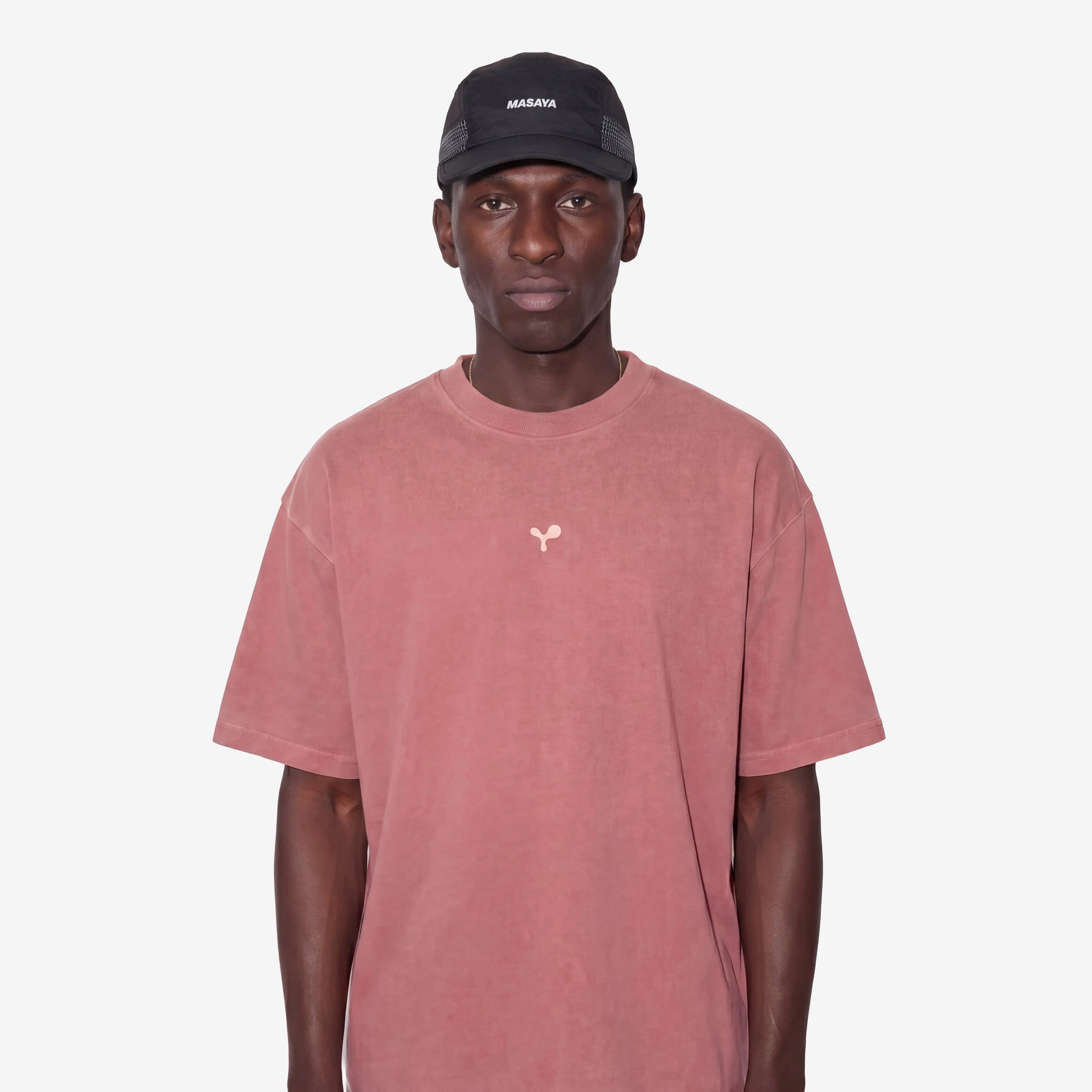
We put a 30 x 30 cm flock panel on the back of every Core Tee and a 3 x 3 cm icon on the chest. This is what we have learned from the wearing side.
What flocking actually is
Flock is short textile fibre — cotton, rayon, or synthetic — bonded upright onto an adhesive film, then heat-pressed onto the garment. The fibres stand perpendicular to the fabric, which is why the surface reads as velvet or suede rather than as ink. You feel it before you see it.
That upright fibre structure is the whole point. Light hits the ends of the fibres rather than a flat surface, so the print shifts as you move. A flocked logo looks different across a room than it does at arm’s length.
How it differs from puff print
Puff is ink with a foaming agent. Heat activates it and the ink rises into a smooth, rounded dome. Both techniques give you height off the fabric, but they are not the same material and they do not age the same way.
| Flocking | Puff | |
|---|---|---|
| Material | Textile fibre on adhesive film | Plastisol ink with foaming agent |
| Surface | Velvet, matte, directional | Smooth, rubbery, uniform |
| Feel | Soft, warm | Firm, slightly tacky |
| Fails by | Fibres shedding at the edges | Cracking across the raised area |
Puff cracks. Flock sheds. Which failure you would rather live with is mostly a question of taste, but they are genuinely different problems.
The durability question, answered honestly
Most guides will tell you flock is prone to falling off in the wash. That is true of cheap flock, and it is worth understanding why rather than treating it as a property of the technique.
Three things decide whether a flock print survives:
Fibre density. Sparse flock leaves adhesive exposed between fibres. Exposed adhesive abrades, and once the edge lifts, the rest follows. Dense flock protects its own bond.
Adhesive and press temperature. The adhesive has to reach full cure. Under-pressing looks identical on day one and fails on wash four. This is the single most common reason a flock print goes patchy, and it is invisible at the point of sale.
What happens after. Heat is what breaks the bond. Not water, not detergent, not time.
So the honest version is: flocking is not inherently fragile, it is inherently sensitive to heat. Treat it accordingly and it outlasts the garment.
How to keep it
Cold wash at 30°C. Turn the garment inside out so the flock faces away from the drum and rubs against fabric rather than against other clothes. Skip the tumble dryer entirely — that is the one instruction that matters more than the rest combined. Do not iron the print directly; if you must iron, go around it or press from the reverse with a cloth.
Line dry and the panel keeps its nap for years. Tumble dry once at high heat and you will see the difference immediately.
Why we use it
We print on 260 gsm cotton that has been washed before printing rather than after. Washing first means the shrink has already happened, so the print sits on fabric that has stopped moving. Printing on unwashed cotton and washing afterwards pulls the fabric under the print, which is another way flock gets destroyed early.
The trade-off is that every piece comes out slightly different. Vintage wash is not uniform, and a flock panel on a non-uniform ground reads as a made object rather than a printed blank. That is the look we are after, and it is why the technique is worth the extra care it asks for.